
Concept Design to Delivery: Where Custom Jewelry Orders Stall
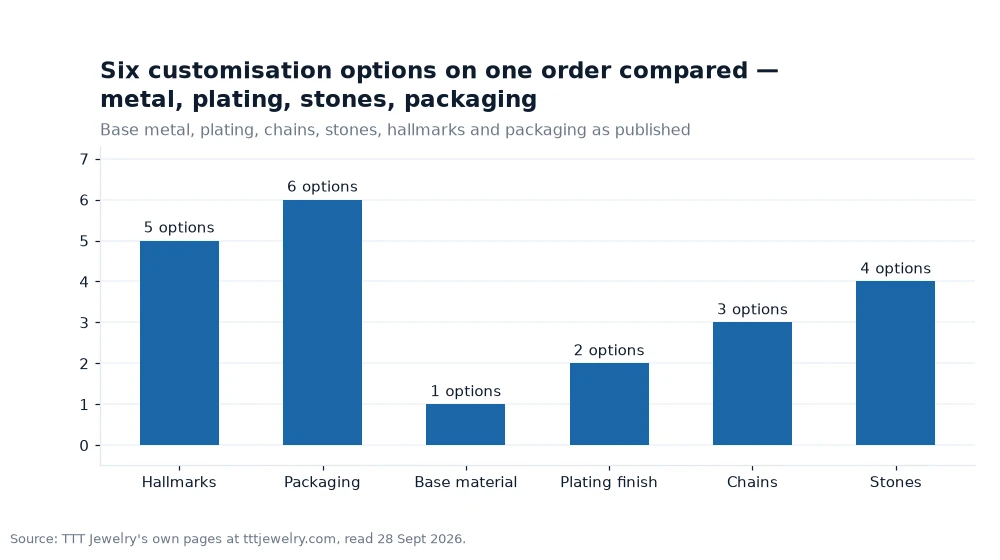
Custom orders rarely stall at the bench; they stall at a decision nobody closed. Six customisation options have to be fixed before the metal is cut — base material, plating, chains, stones, hallmarks and packaging — while the published clock runs at a 48-hour CAD turnaround, a 25–30 day sampling window and 3–4 weeks of production for production.

Key takeaways
- Six published options decide the order: base material, plating and finishes, chains, stones, hallmarks and packaging.
- 3D CAD closes in under 48 hours, sampling takes 25–30 days, and production runs 3–4 weeks after approval.
- The MOQ by base material is 50 pcs in 925 sterling silver, 100+ in the stainless line and 100 units in artisan brass, design by design, applied design by design.
- Final QC is a 100% inspection, so a decision discovered there costs a batch rather than a piece.
Six decisions behind one order
Every custom order is six decisions wearing a single product code. The base material decides the minimum. The plating decides the colour and the wear route. Chains and findings, stones and accents, and the logo or hallmark come next, and packaging closes the list.
Order matters, because most of the six touch the metal or the surface. A stone added after polishing is a reset; a chain swapped after plating is a second assembly; a box ordered after the carton is packed is a shipment waiting in a corridor.
The stall points are decisions, not machines
When a batch is late, the cause is usually one of three things: a dimension nobody approved, a finish nobody wrote down, or a packaging item nobody ordered. None of those is a production problem, and all three appear in the published option list rather than in the eight factory steps.
That is why the useful question before a first order is not how fast the factory is, but which of the six options the brief already answers. The CAD stage is where a gap costs the least to close, because it costs screen time rather than bench time.
| Option | Choices published | What an open decision costs |
|---|---|---|
| Base material | 925 sterling silver, brass, stainless steel | The minimum per design, and the plating route |
| Plating and finishes | 14K, 18K or 24K gold, rhodium, anti-tarnish e-coating, PVD | A second pass through the tank if it changes late |
| Chains and findings | Selected with the piece | A finished batch with nothing to hang it on |
| Stones and accents | Natural stones, freshwater pearls | A setting stage re-run |
| Logo and hallmarks | Laser engraving, 316L on stainless, 18KGP on gold-plated work and the S925 hallmark marks | Unmarked pieces that cannot be corrected after plating |
| Packaging | Tags, foil-stamped boxes, pouches, backing cards, barcodes | A finished order that cannot ship to retail |
Why the CAD stage absorbs the most risk
Everything that can be changed on a screen belongs in the 48-hour CAD window, and everything that cannot belongs in the brief. Dimension, proportion, stone placement and the position of an engraved logo are all screen decisions, which is why the render is worth reading closely rather than approving quickly.
What the CAD file cannot settle is colour and packaging, because those are physical. Both are decided in words, which means both are worth writing down before the file goes out rather than describing over a call after the sample arrives.
Worked example: six approvals on a 60-day schedule
Count the decisions as approvals. Six options, each closed with a single written answer, is six approvals. If each one takes a day of email, that is 6 days of elapsed time. Measured against a fast order of roughly 60 days of factory time, that is 6 ÷ 60 = 10% of the schedule.
Now assume each approval takes a week instead. The same six decisions consume 42 days, which is longer than the entire 25–30 day sampling window. Nothing on the factory floor changed in either scenario; only the speed of the answers did.
Where the order slips on the supplier's side
The one failure that is genuinely the supplier's is a stage that quietly leaves the building. If the plating tank belongs to another company, your finish question is answered by whoever runs that tank, and a colour mismatch becomes a three-way conversation.
A jewelry factory for brands that owns its own stages answers those questions directly: which finish stack went on, which hallmark applies, and which pieces were pulled at the 100% inspection. Ask for that list at the quotation stage, when it is still a selection question rather than a dispute.
What to fix before the sketch leaves your desk
Write the six answers in a single message, even if two of them are provisional. Material, finish, chain, stones, mark and packaging. A provisional answer that says rhodium with a 14K alternative still lets the CAD work start, while an open question stops it.
The same message should name the first-run quantity, because that is what decides whether the design as drawn is viable. Sterling silver starts at 50 pieces per design, brass at 100 and stainless steel at 100+, so a design that only works at 30 pieces in brass is a design that needs a different base metal.
Keeping the six options visible through the run
Put the six decisions on one sheet with a status against each, and update it when the sample is reviewed. A 1-on-1 project manager is useful precisely because that sheet has an owner, with a 24-hour response on each question and a 100% NDA covering the drawings, the moulds and the collection itself.
By the time production starts, the sheet should read as six closed items. Anything still open at that point is a change to a mould, a tank or a box, and all three are more expensive than the sentence it would have taken to close them.
The three gates that catch an open decision
An unresolved decision surfaces at one of three gates. The CAD review catches anything visible on a rendering: proportion, stone placement, engraving position. The sample review catches anything physical: colour, weight in the hand, how a clasp closes. The inspection catches everything else, which makes it the most expensive place to learn that something was never decided.
Working those three gates in order is the simplest project management available on a custom order, and it needs no software: one page, six lines, three checkpoints.
What a closed decision looks like on paper
A closed decision is a line with a value on it: 925 sterling silver, rhodium finish, natural stone, S925 hallmark, foil-stamped gift box. Anything phrased as a direction rather than a value is still open, including preferences such as something between two colours.
Turning a preference into a value is the buyer's job rather than the factory's, and it takes one lookup: finishes are published as 14K, 18K, 24K and rhodium, so the middle of a colour range is one of four codes instead of a conversation.
Frequently asked questions
What are the six customisation options for a custom order?
The six customisation fields run: finishes and plating, hallmarking and logo, packaging specification, stones set as accents, chains and findings and the base metal.
How long does it take before the six options are locked?
CAD is quoted at under 48 hours and the master sample at 25–30 days, and the six options are normally settled between those two gates rather than after the sample.
Which option is most often forgotten?
Packaging, followed by the hallmark. Both are decided in words rather than on screen, so neither shows up in a CAD review unless someone asks.
A short list beats a long negotiation
Six answers in one email will do more for a launch date than any specification meeting. TTT Jewelry publishes the full option set and the OEM/ODM structure, with the questions page covering the short form and the wholesale program page explaining how a first range is put together around it.
The figures used above — the 100% checking rule together with the eight steps in production as well as the ISO 9001:2015, BSCI and REACH claims — are drawn from the brand's own pages through tttjewelry.com, which I read through on 28 Sept 2026. The unit conversions belong to me rather than the client[1].